Last updated: July 7, 2026
Your battery speaks DC. Your espresso machine, griddle, and fridge speak AC. The inverter translates between them — and sizing it wrong is the most common (and most expensive) mistake in a food truck battery conversion.
Size your inverter to match or exceed the sum of nameplate watts on every device that can run simultaneously. If your total is 13 kW, you need at least a 13 kW inverter — round up to the next standard size (15 kW). For most food trucks that lands at 6–15 kW continuous on a 48V pure sine wave system.
Skip modified sine wave — it kills sensitive electronics and induction motors. Pick a hybrid inverter from a name you can find a manual for (EG4, Victron, Sol-Ark, Growatt) so you have built-in shore-power charging, MPPT solar inputs ready for later, and a real warranty.
Inverters list two watt numbers: continuous and surge (peak). Surge ratings exist to handle the brief inrush when motors and compressors start — typically 1.5–3× their running watts for a few seconds. Do not use the surge rating to justify a smaller inverter.
If your truck totals 13 kW continuous and you buy a 10 kW inverter because its 20 kW surge "covers" you — it will eventually fault. Running an inverter at its surge limit repeatedly overheats the electronics and shortens its life dramatically.
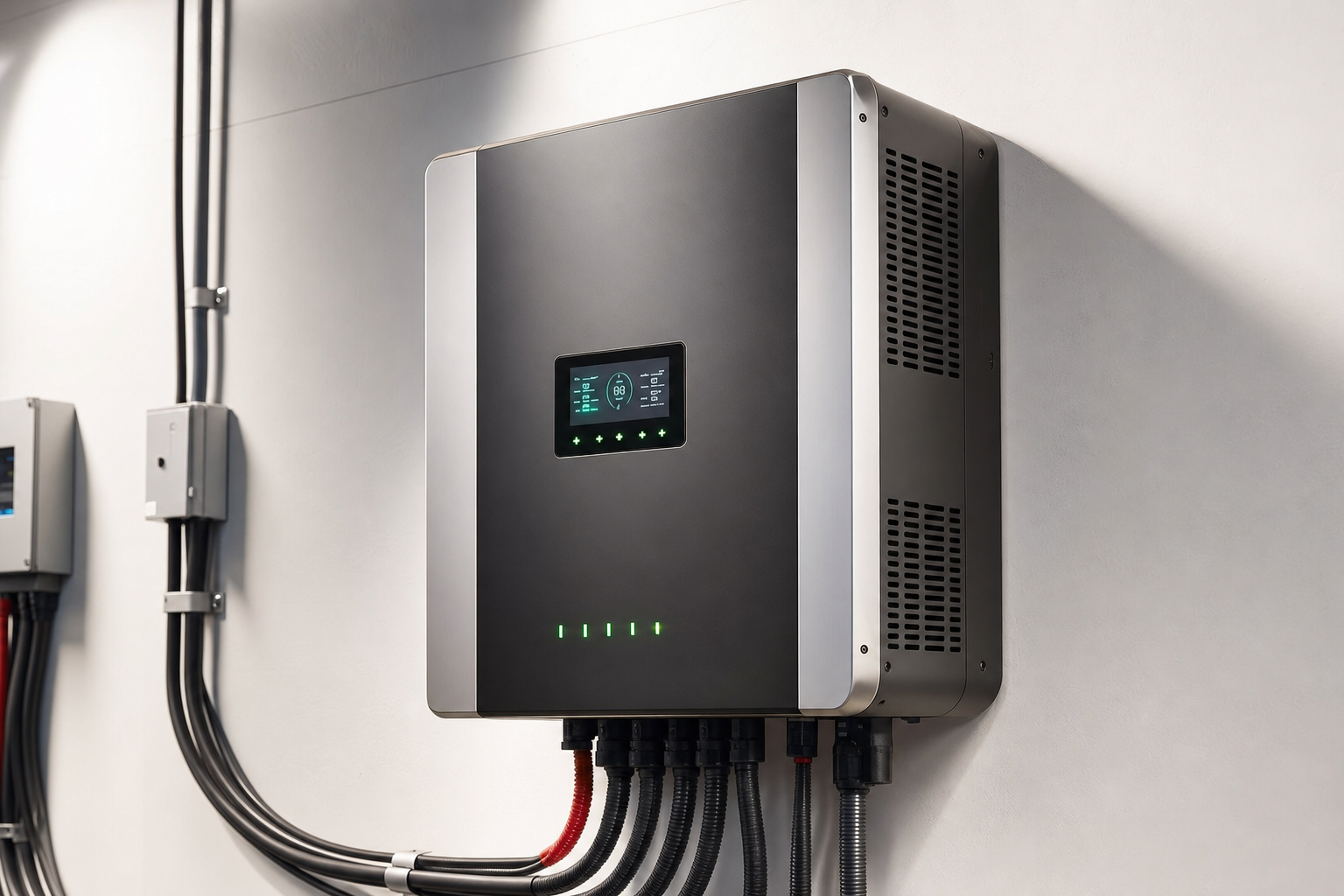
It turns the battery's DC into the AC your kitchen equipment expects. Same job as the wall outlet at home — powered by your battery stack instead of the utility.
Every piece of commercial kitchen equipment you plug into a standard wall outlet runs on AC power — 120V or 240V, at 60 Hz (in North America). Your LiFePO4 battery bank stores energy as DC — typically at 48V. The inverter takes that 48V DC and converts it into clean 120V or 240V AC power, identical to what comes out of a wall outlet.
An inverter isn't just a simple transformer. It's a sophisticated piece of power electronics that contains:
The systems we recommend use a 120/240V split-phase inverter. Split-phase means the inverter outputs two 120V "legs" that are 180° out of phase: any 120V device runs off a single leg, and any 240V device (a large griddle, a big flat-top, some HVAC) runs across both legs. One box covers your whole truck — 120V accessories and 240V high-draw gear alike — which is why the calculator no longer asks you to pick a voltage per device.
On the AC side it wires like the grid feed you already know: two hot legs (L1/L2), a shared neutral, and ground land in your truck's distribution panel exactly where a shore-power feed would. Your 120V branch circuits pull from one leg to neutral; any 240V circuit pulls leg-to-leg. This is standard, code-familiar wiring for any RV/food-truck electrician — the split-phase inverter simply becomes the source when you're off shore power. See the AC wiring walkthrough for how the panel tie-in goes together.
Continuous watts (what runs all shift) and surge watts (what the inverter can deliver for a few seconds when motors start). Your inverter must beat both numbers for your worst-case simultaneous load.
When sizing an inverter for your food truck, you need to understand two numbers:
How much power the inverter can deliver all day long without overheating. This is the number you size against.
The nameplate rating is the number printed on the device's specification label — usually on the back or bottom. It represents the maximum power the device can draw during normal operation. Not all devices run at their nameplate rating all the time (a fridge cycles on and off, a thermostat-controlled griddle throttles), but you size the inverter for the theoretical maximum when everything runs at once.
How much power the inverter can handle in short bursts — typically 5 to 10 seconds. This covers the startup surge when motors and compressors kick on.
Most quality inverters handle 2x their continuous rating for short surges. So a 6 kW inverter can typically handle 12 kW surges. PowerCheck tracks your aggregate surge watts and cross-checks against the inverter's surge capacity to make sure startups won't cause problems.
A working coffee truck running an espresso machine, grinder, fridge, exhaust hood fan, and lighting at once totals 8.5 kW nameplate — which rounds up to a 10 kW inverter. The inverter's built-in 2x surge rating covers every motor startup without tripping. No extra multiplier needed.
Here's how inverter sizing works in practice. This is a real coffee truck setup with a 6-hour shift:
| Equipment | Nameplate Watts | Surge Watts | Notes |
|---|---|---|---|
| Espresso Machine (2-group) | 2,800 W | 2,800 W | Heating element, no motor surge |
| Coffee Grinder | 800 W | 1,200 W | Motor — brief surge on startup |
| Refrigerator (under-counter) | 450 W | 1,350 W | Compressor — 3x surge |
| Water Heater (6 gal) | 1,500 W | 1,500 W | Heating element, no surge |
| Exhaust Hood Fan | 1,400 W | 1,400 W | Motor (inverter handles startup) |
| Mini-Split AC | 1,200 W | 2,400 W | Compressor — 2x surge |
| POS System | 100 W | 100 W | Electronics, no surge |
| Interior + Exterior Lighting | 150 W | 150 W | LED, no surge |
| Phone/Tablet Chargers | 50 W | 50 W | — |
| TOTAL | 8,450 W = 8.5 kW | 10,950 W = 11.0 kW |
All commercial food truck battery systems run at 48 volts DC. This isn't a preference — it's a requirement driven by physics.
A typical food truck pulls 5-8 kW of continuous power. At 48V, that's 100-170 amps — manageable with standard commercial wiring and connectors. The math is straightforward:
| Load | Current at 48V | Wire Size | Typical Application |
|---|---|---|---|
| 3 kW | 62.5 amps | 6 AWG | Light coffee truck, minimal cooking |
| 5 kW | 104 amps | 4 AWG | Standard coffee or sandwich truck |
| 8 kW | 167 amps | 2 AWG | Full taco/burger truck with AC |
| 10 kW | 208 amps | 1/0 AWG | Heavy setup with multiple cooking stations |
| 12 kW+ | 250+ amps | 2/0 AWG+ | Large trucks with soft serve + full kitchen |
At 48V, all of these loads use reasonable wire sizes and commercially available breakers, fuses, and connectors. The battery bank is configured as 16 LiFePO4 cells in series (16s), with each cell at 3.2V nominal. Battery capacity is measured in amp-hours (Ah) at 48V — for example, a 100 Ah battery at 48V stores 4,800 Wh (4.8 kWh).
| Battery Capacity (Ah @ 48V) | Stored Energy (kWh) | Typical Shift Coverage |
|---|---|---|
| 100 Ah | 4.8 kWh | Light truck, 4-6 hour shift |
| 200 Ah | 9.6 kWh | Standard truck, 6-8 hour shift |
| 300 Ah | 14.4 kWh | Heavy truck or long shift (10-12 hours) |
| 400 Ah | 19.2 kWh | Full kitchen, all-day event with no shore power |
Always pure sine wave. Modified sine inverters are cheaper but they damage sensitive electronics, run motors hot, and cause induction cooktops, variable-speed compressors, and microwaves to misbehave. Not worth the savings.
You'll see two types of inverters sold. This choice is critical for food trucks.
Produces clean, smooth AC power identical to what comes from the power grid. This is what your food truck must use.
Produces a choppy, stepped approximation of AC power. Cheap, but not appropriate for commercial food equipment.
High-frequency inverters are lighter and cheaper and handle most food-truck loads cleanly. Low-frequency designs absorb motor inrush more aggressively but are heavier and rarely needed once you size for surge headroom.
Within pure sine wave inverters, there are two fundamentally different designs. The difference comes down to the transformer inside.
| Feature | High Frequency (HF) | Low Frequency (LF) |
|---|---|---|
| Transformer type | Small ferrite core, high-speed switching | Large copper-wound toroidal transformer |
| Weight (6kW unit) | 25-45 lbs | 70-120 lbs |
| Continuous surge capacity | 2x rated power for 5-10 seconds | 3x rated power for 10-20 seconds |
| Cost (6kW unit) | $800-$2,000 | $1,500-$3,500 |
| Efficiency at full load | 92-95% | 90-93% |
| Efficiency at light load | Better (lower idle draw) | Worse (transformer always draws some power) |
| Motor handling | Good for standard motors | Superior — heavy transformer absorbs motor inrush current better |
| Noise | Quieter (fan only) | Slight transformer hum under heavy load |
| Durability | More electronic components = more potential failure points | Fewer components, transformer is nearly indestructible |
| Best for | Most food trucks — coffee, taco, burger, pizza, sandwich | Trucks with large compressor loads — soft serve, frozen drinks, multiple walk-in units |
Every hybrid inverter has a built-in charger that runs the system in reverse when shore power is plugged in — your truck runs off shore power directly and the surplus tops up the battery. That's the right way to recharge while you're parked. It's not the right way to add power while you're actively serving customers — see the callout below.
Most food truck inverters include a built-in battery charger. Here's how the charging cycle works:
| Outlet Type | Voltage | Max Amps | Max Charging Power | Best For |
|---|---|---|---|---|
| Standard 20A outlet (NEMA 5-20) | 120V | 16A (80% rule) | 1,920W | Light systems only — slow charge |
| 30A RV outlet (NEMA TT-30) | 120V | 24A (80%) | 2,880W | Most food trucks — overnight charge |
| 50A RV outlet (NEMA 14-50) | 120/240V | 40A (80%) | 9,600W | Fast charge — can fully recharge in 2-3 hours |
Modern hybrid inverters run at 92–95% efficient under load. That 5–8% loss shows up as heat — which is why ventilation matters — and as a small tax on your usable kWh. Plan for it; don't be surprised by it.
No inverter is 100% efficient. Some energy is lost as heat during the DC-to-AC conversion. This matters because the lost energy comes out of your battery.
We sum the nameplate watts on every device that can run at the same time. That total IS your minimum inverter size — we round up to the next standard unit. No arbitrary multiplier. Surge capacity is handled separately.
The calculator uses your equipment list to calculate three values that determine your inverter requirements:
The sum of all your equipment's nameplate watt ratings. This is the maximum continuous power your system could theoretically draw if everything ran at full power simultaneously.
Your inverter's continuous rating must exceed this number.
The sum of all equipment surge ratings. Compressors and motors draw 2-3x their running watts for a few seconds at startup. This number tells us the worst-case startup scenario.
Cross-checked against inverter surge capacity as a safety margin.
Based on your equipment mix, PowerCheck recommends a continuous size from the standard inverter range, plus surge-headroom guidance for heavy compressor loads (soft serve, slushy, frozen drinks).
Soft serve and frozen drink machines trigger an extra surge-headroom note so you size up rather than trip mid-shift.
Minimum inverter that meets your total kW, with slightly less battery kWh than your spec. Lets you make the switch, run a hybrid setup alongside your existing generator, and get comfortable with the system before going fully off-gen.
The closest package that meets or exceeds both your total kW (inverter) and total kWh (batteries). This is the right-sized system for your current operation — fully independent, no generator needed.
The next size up from your Best Match — more kW and more kWh than your current spec. Lets you add equipment or run longer shifts later without changing anything. Electronics run longer at 80% capacity than at 100% — this tier builds that headroom in from day one.
The three big ones: undersizing for simultaneous loads, buying modified sine wave to save money, and skipping ventilation. All three are reversible only by replacing the inverter — which is expensive.
These are the errors we see food truck owners make most often when setting up battery systems:
Buying a 3 kW inverter for a truck that pulls 6 kW. The inverter will either shut down on overload or run at redline, dramatically shortening its life. Size for your full load, not your average load.
Saves $200 upfront. Costs thousands in damaged equipment, shortened compressor life, and unreliable POS systems. Pure sine wave is the only option for food trucks.
A 6 kW load at 12V means 500 amps flowing through your wires. That requires welding-cable-thick wiring and creates serious fire risk at every connection. Use 48V for any food truck application.
Buying a standalone inverter without a built-in charger means a separate charging setup. Inverter-charger combos are simpler, safer, and include the transfer switch you need for seamless shore-to-battery switching.
An uncertified inverter might work today but has no independent verification of its safety circuits, thermal protection, or fire resistance. When (not if) something goes wrong, you want an inverter that was designed to handle it.
LiFePO4 batteries need specific charge profiles — different voltage limits than lead-acid or NMC lithium. Using an inverter-charger that doesn't support LiFePO4 can undercharge (reducing capacity) or overcharge (damaging cells).
Quick answers to the inverter-sizing questions food truck owners ask most.
Size to the next standard inverter at or above your peak simultaneous load, not your average load. Most food trucks need 3,000–8,000 W continuous. Trucks with soft-serve, slushy, or frozen-drink compressors need extra surge headroom — typically a 10–12 kW unit with a 2–3x surge rating. Run the calculator to get an exact number from your equipment list.
Yes, for most trucks with electric cooking loads under 6 kW continuous. A correctly sized LiFePO4 battery and inverter can fully replace a generator for a typical service day. Heavier loads may need a hybrid setup — see the battery vs generator breakdown.
If you already run a generator, its rated wattage and typical fuel burn tell us how much load your truck actually draws. The calculator can size a battery + inverter system directly from those numbers — no need to re-list every appliance if you'd rather start from what your generator already tells you.
Compressors, motors, and espresso machines draw 2–3x their running watts for a fraction of a second at startup. An inverter with enough continuous capacity but a weak surge rating will trip mid-service. Always check the surge spec, not just the continuous number.
Free calculator — size your inverter from your equipment list, your current generator's specs, or its fuel burn. Take the spec to any vendor or click Buy Now.
Use the food truck battery calculator →If you found this helpful, these next pages go one layer deeper.
Free. No signup. Size from your equipment, generator specs, or fuel burn — then take the spec to any vendor or click Buy Now.