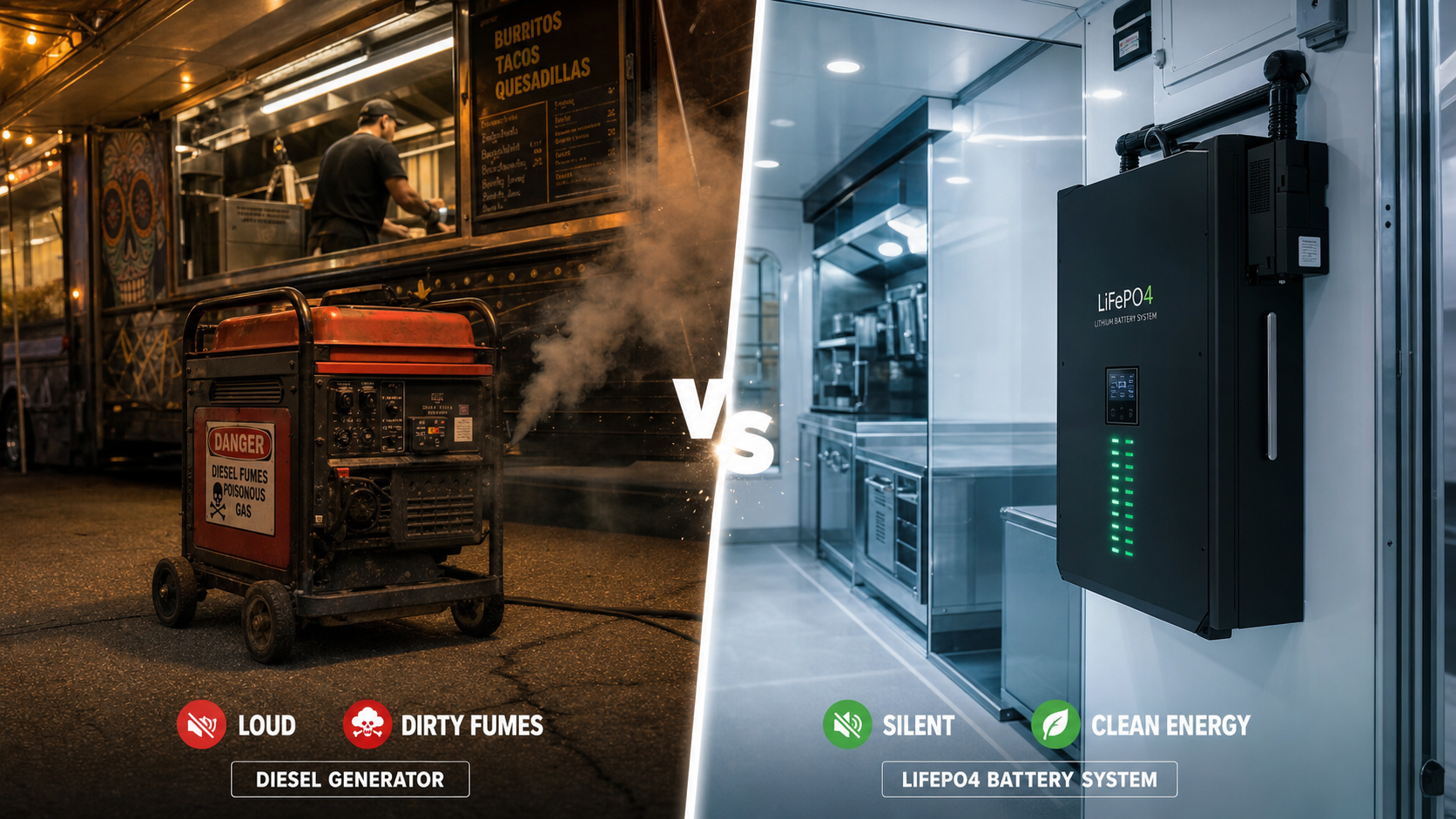
Bottom Line
For a busy food truck (250–300 service days/yr), batteries beat generators on total cost within 12–24 months — and the gap widens every month after that. A mid-size battery system runs you ~$8,000–12,000 up front but costs roughly $300/yr in shore-power electricity. A "cheap" 7.5kW generator costs $1,000–1,300 up front but burns through $9,000–15,000 of fuel and $500+ of maintenance over five years.
The generator wins exactly two cases: one-off remote events with zero grid access, and trucks that operate fewer than 50 days a year. Everyone else is paying a silent gas tax for the privilege of being noisy. For those trucks, a battery system is the right generator replacement — permanent, silent, and cheaper to operate within 18 months. For a full walkthrough of replacing a generator with battery power, see our guide with named operators and real cost figures.
You Don't Have to Go All-In on Day One
The full battery rig is a long-term answer, not a Day-One ultimatum. You can start with a smaller pack, keep your existing generator on the truck as backup, and grow the battery side as the math (and your comfort) catches up.
Most owners don't flip a switch from "generator truck" to "all-battery truck." A battery system is the best generator replacement available for food trucks, but the transition works better in stages than all at once. The honest path looks more like this:
- Start where you're comfortable. Size the battery for a realistic chunk of your shift — say, 60–70% of a full day — not the 110% worst-case festival weekend. Smaller pack, smaller check, fewer moving parts to learn.
- Run hybrid: battery first, generator as backup. The inverter handles every device on the truck silently, all the time. The generator stays bolted to the rig, wired to a dedicated external charger at the battery terminals (not the inverter), and only fires up to backfill the battery when you need it — long catering runs, dead-grid events, an unexpectedly busy Saturday. You get the quiet, clean-air operating profile most of the time, the safety net the rest of the time, and no risk of overloading a weak feed since the battery still carries the full load. See our hybrid systems guide for how the external charger works.
- Add a module later when you're ready. Modern LiFePO4 systems (ETHOS, EG4 WallMount, BigBattery rack-mount) are designed to expand. Buying one more battery module 6 or 12 months in is a half-day job for an electrician — not a re-do. The inverter, wiring, mounting, and shore-power inlet are already in place. You just add kWh.
- It's OK to scale in. A 10 kWh starter pack that you actually use beats a 30 kWh dream system that scared you out of buying anything. The point of the calculator is to tell you the right ceiling — you choose where on that ladder to start.
The hybrid bridge is a feature, not a compromise. Keeping your generator on the truck during the first season buys you confidence. Most owners realize within 60 days that they never start it, and sell it or move it to backup-only duty. By then you know exactly how much more battery you actually want.
Need to figure out where to start? Use the food truck battery calculator to see your full-shift number — then pick the rung of the ladder that fits your wallet and your nerves today.
"But the generator is cheaper, right?"
On the showroom floor, yes. Once you start running the truck, no — and it's not even close.
Every food truck owner asks this question. A 7,500-watt portable generator from Home Depot is $1,000–1,3001. A battery + inverter system that does the same job is $8,000–12,000. That looks like an open-and-shut case.
It isn't, for one reason: a generator's price tag is the smallest cost it will ever have. Fuel is recurring. Oil changes are recurring. Spark plugs, air filters, and carbon-monoxide-detector batteries are recurring. Venue noise complaints — increasingly common as cities adopt sound ordinances — can shut you down for the night or for the season2.
A battery system has the opposite cost shape: a big check on day one, then almost nothing. The electricity to recharge it overnight at commissary or shore power costs roughly 14¢/kWh in the U.S. on average3. That's about $2.50 per full charge of a 18 kWh system. Compare that to $30–60 a day in gasoline.
No generator, no problems. Silent operation. Zero exhaust. No fuel runs. No oil changes. No 2 AM trip to the gas station because Saturday breakfast service ate through the tank early. That's the actual product. The 5-year cost savings is a bonus.
Initial Cost — What You Actually Spend on Day One
A complete battery system costs 7–10× more up front than a comparable generator. That's the honest sticker shock. So how much is a generator for a food truck? Expect $1,000–$5,500 up front — but the true cost of a generator for a food truck isn't the purchase price, it's the fuel and maintenance below.
Generator — Day 1
$1,000 – $5,500
What you're buying
- Champion 7500W dual-fuel (6,000W rated): ~$1,000–1,3001
- Honda EU7000iS inverter generator (5,500W rated): ~$4,800–5,5004
- 5-gal jerry can + funnel: $40
- Heavy-duty outdoor extension cord (50ft 10ga): $80
- Generator cover + tie-downs: $60
- Carbon monoxide detector (required indoor use): $25
Battery System — Day 1
$8,000 – $12,000
What you're buying
- EG4 PowerPro Outdoor 14.3 kWh battery: $3,9995
- EG4 18kPV hybrid inverter (18 kW, MPPT-ready): $4,8986
- Battery cables, lugs, fuses, busbars: $300–500
- Shore-power inlet (50A) + cordset: $250
- Mounting brackets + secure enclosure: $200–400
- Install labor (8–14 hrs): $700–1,200
Honest comparison: The generator wins on Day 1 by roughly $7,000. If you only ever ran the truck for a single weekend a year, that gap would never close. The question is whether you'll run the truck enough days for the operating-cost difference to overtake the initial-cost gap. For almost any real food truck, the answer is "yes, within 18 months."
Operating Cost — Fuel vs Grid Electricity
Gasoline costs roughly 7× more per kilowatt-hour than commercial grid electricity. Diesel costs 11×.
$1.01
per kWh — Gasoline generator
$3.04/gal ÷ ~3 kWh delivered
7×
more
$0.14
per kWh — Grid electricity
14.37¢/kWh commercial avg
This is the single biggest reason batteries win the long game. Every kilowatt-hour you pull out of a generator comes from burning liquid fuel. Every kilowatt-hour you pull out of a battery comes from the wall, where electricity is cheap.
What that means in practice: A truck that uses 15 kWh of energy per service day pays about $15.15 in gas through a generator, vs $2.16 in grid electricity charging the battery overnight. Same energy delivered. Different cost by 7×.
Maintenance — The Cost Everyone Forgets
Generators need an oil change every 100–150 hours of run-time. LiFePO4 batteries need essentially nothing.
A 7–10 kW portable generator running 6 hours a day during a busy season hits its oil-change interval roughly every 3 weeks. Manufacturers like Generac, Honda, and Champion all specify oil + filter changes every 100–150 hours of continuous operation; a standby unit running fewer hours can stretch to 250–30013.
EcoFlow's published maintenance-cost guide puts a small portable generator (7–10 kW range) at $100–200/year just in scheduled service, not counting the cost of unscheduled repairs14. The $185–845 range above reflects whether you do the work yourself or pay a small-engine shop.
The cost shape is opposite. A generator costs less to buy and more to own. A battery system costs more to buy and almost nothing to own. The breakeven point depends on how many days a year you actually run the truck — which is the whole point of the next section.
A Concrete Example — "The Birria Truck"
A high-volume truck running 300 days/year with 18 kWh of daily power use, in the same 7,600W-running generator class — priced at both a budget and a premium tier. Here's the full 5-year math for each.
Generator price scales with build quality far more than with wattage — a budget and a premium unit at the same power output can differ by 2–3× in price. So instead of picking one generator, we ran the numbers for both ends of the market at this truck's exact power class:
- Energy use: 18 kWh per service day (two cooking appliances + espresso + cold storage16)
- Service days: 300/year (6 days/week, 50 weeks)
- Run hours on generator: ~7 hours/day at variable load
- Budget generator: Predator 9500 Super Quiet inverter generator (7,600W running / 9,500W peak) — $2,205 all-in (unit + accessories)15
- Premium generator: Honda EU7000iS inverter generator (5,500W rated / 7,000W peak) — $5,100 all-in (unit + accessories)4
- Battery system: EG4 PowerPro 14.3 kWh + EG4 18kPV inverter + install, ~$10,500 turnkey
- Gasoline: $3.04/gal7, ~3 kWh/gal delivered (same for both generators)
- Commercial electricity: 14.37¢/kWh10
- Maintenance: $400/yr budget tier (DIY service, no dealer network)15 vs $700/yr premium tier (dealer service schedule)4
Cumulative 5-Year Cost — Generator (Budget & Premium) vs Battery System
Monthly spend over 60 months. Battery crosses the budget generator around month 20, and the premium generator around month 13.
Premium generator (Honda-class)
Budget generator (Predator-class)
Battery system (purchase + electricity)
Battery savings zone (vs premium)
Breakeven at Month 13 (premium generator) to Month 20 (budget generator) — battery cheaper every month after
Year-by-year cumulative cost
Fuel cost is identical for both generators: $5,472/yr (18 kWh × 300 days ÷ 3 kWh/gal × $3.04). Budget generator annual cost = $5,472 fuel + $400 DIY maintenance = $5,872. Premium generator annual cost = $5,472 fuel + $700 dealer service = $6,172. Battery annual cost = $776 electricity (18 kWh × 300 days × $0.1437). Numbers assume flat fuel and electricity prices — both have historically risen, so the battery advantage grows over time.
$31,565–$35,960
5-yr generator total (budget–premium)
$14,380
5-yr battery total
13–20 months
Time to breakeven
Budget or premium, the battery still wins — just on a different timeline. A $2,205 Predator-class generator takes longer to catch up (breakeven ~Month 20) than a $5,100 Honda-class one (breakeven ~Month 13), simply because there's less purchase-price gap to close. But fuel and maintenance don't care what badge is on the generator: both tiers burn the same $5,472/year in gas at this usage rate, so by Year 5 even the cheap generator has cost $31,565 — more than double the battery's $14,380. The premium generator is quieter and better-built, which is worth paying for on its own merits, but it isn't why the battery wins long-term. The battery wins because it has (almost) no fuel bill.
The Hidden Costs of Running a Generator
Noise, exhaust, and venue bans don't show up in a spreadsheet — but they decide whether you can park where the customers are.
Noise — and the venues that won't let you in anymore
A Honda EU7000iS — one of the quietest portable generators on the market — runs at 58 dB at quarter load4. A Champion 7500W dual-fuel runs at 74 dB16. For comparison, a normal conversation is 60 dB; a vacuum cleaner is 70 dB. Now imagine that noise running next to your pickup window for 6 straight hours.
Normal conversation
60 dB
Battery system (inverter fan)
<35 dB
Note: dB is a logarithmic scale. 74 dB is not twice as loud as 35 dB — it's roughly 100× more intense. Every 10 dB doubles perceived loudness.
Cities are increasingly regulating this. Decatur, Georgia limits generator operation to 60 dB during quiet hours (10 PM – 7 AM) and bans them entirely in some downtown event zones2. Minneapolis has run public conversations about quieter food trucks for nearly a decade17. Many breweries, weddings, and corporate events now write "no generators" directly into their vendor contracts.
Exhaust — fumes drifting into your prep area
Generator exhaust contains carbon monoxide, unburned hydrocarbons, and NOx. On a truck parked with the wind in the wrong direction, those fumes drift over your prep table and into your service window. Battery systems emit zero exhaust. Zero CO. Zero anything.
The 2 AM fuel run
A Champion 7500W burning at 50% load uses ~7.7 gallons over 11 hours18. A Honda EU7000iS uses about 5.1 gallons over 16 hours at quarter load4. Two long service days back-to-back and you're at the gas station with five jerry cans in the back of your pickup. A battery just plugs in when you get home.
The intangible win. Half of the food truck owners who switch to batteries tell the same story: the first time they ran service with no generator drone in the background, they realized how much that noise had been wearing them down for years. You can't put that on a spreadsheet — but it's real.
When the Generator Still Wins
There are two specific scenarios where a generator is genuinely the right call. We'll be honest about them.
- One-off remote events with zero grid access. A music festival in the middle of nowhere, a 3-day fair in a field with no shore power, a wedding at a backcountry venue. For a 72-hour push where no shore power exists anywhere on site, the math flips — you need fuel, and you need a lot of it. (Even here, the increasingly common play is to bring batteries plus a small generator as a backup charger.)
- Trucks operating fewer than 50 days a year. A side-hustle truck that does 3–4 events per month will never burn enough fuel to overtake the up-front cost of a battery system. The breakeven for our example truck stretches to 20+ years if you only run it 50 days a year. At that point, just buy the generator.
For everyone else — anyone running a real food truck business 150+ days a year — the battery system is the correct financial choice, full stop.
Food Truck Equipment Wattage Chart
Running watts vs startup surge for the most common food truck appliances. These numbers come from FoodTruckBattery.Com's equipment database, cross-validated against manufacturer nameplate data.
Why this matters: a generator or inverter has to handle the peak instantaneous draw, not the average. A compressor at rest draws zero watts. The same compressor at startup can spike to 2–3× its running value for half a second — enough to trip an undersized inverter and stall the entire system.
The duty-cycle math most guides skip: Compressor running watts are roughly nameplate / 3, because the compressor only runs ~30% of the time on a thermostat. Most generator-sizing guides assume 100% duty cycle and end up recommending a 2× oversized unit. Our
food truck battery calculator applies real duty cycles per appliance — which is why our recommended generator replacement battery and inverter sizes come in 20–40% smaller than competing tools, while still meeting peak demand.
The Inverter Sag Trap — Why Battery Trucks Crash Mid-Service
The #1 failure mode on battery-powered food trucks isn't running out of kWh — it's drawing more peak watts than the inverter can supply at one instant.
The classic scenario: a 3,000W inverter is handling your espresso machine at 2,800W during a morning rush pull. At the exact moment the espresso pump kicks in, your fridge compressor cycles on — a 1,800W surge for two seconds. The inverter sees 4,600W instantaneously. One of three things happens:
- The inverter trips out. Hard shutdown. Espresso machine boots into error state. POS reboots. 90 seconds of dead service before everything comes back up. Customer line backs up.
- The inverter sags voltage. Output drops from 120V to ~95V for half a second. The espresso machine's digital controller errors. The fridge compressor stalls and retries (drawing the surge again, making it worse).
- The inverter thermal-throttles. Repeated peak overruns spike the heatsink temperature. The inverter quietly reduces output. Your espresso machine takes 2 extra minutes per shot. You don't notice until you're 8 customers deep.
The rule of thumb that prevents all of this: Sum the running watts of every device that can run simultaneously at peak, then pick the next standard inverter size at or above that number. Then verify that your largest single-device surge (compressors, motors) fits inside the inverter's surge rating. Surge headroom is what trips you, not continuous draw.
Real example: panini press (1,800W) + fridge running average (150W) + freezer running average (200W) + hood vent (300W) + LED lights (60W) + POS (40W) = 2,550 W sum. Round up to the next standard inverter — a 3 kW unit. Peak instantaneous draw with the freezer compressor surging mid-press = ~4,400 W — well within the surge rating of any 3 kW pure sine wave inverter (typically 6–9 kW surge for 5 seconds).
If you'd rather not do this math by hand, run the calculator — it applies the same formula with real duty-cycle data per appliance and returns the inverter size, battery kWh, and shore-power amperage you need.
Frequently Asked Questions
The questions food truck owners ask us most often when they're deciding between a battery system and a generator.
Is a battery system cheaper than a generator for a food truck?
Over 5 years, yes. A LiFePO4 battery + inverter typically breaks even against a portable generator in 14–28 months when fuel, oil, and maintenance are included. After breakeven, the battery costs roughly $25/year to maintain vs $300–800/year for a generator.
Can a battery really replace a generator on a food truck?
For most trucks with electric cooking loads under 6 kW continuous, yes. Heavy electric griddles or fryers above 5 kW continuous still benefit from shore power or a hybrid setup. About 75% of food trucks fall in the range where a battery can fully replace the generator.
How big a battery does a food truck need?
Most working trucks need 5–15 kWh of usable LiFePO4 capacity for a single 6-hour shift, depending on equipment mix. Coffee trucks: 5–8 kWh. Burger and taco trucks: 10–15 kWh. BBQ and pizza with electric ovens: 18–25 kWh. Run the calculator for an exact spec.
How much fuel does a food truck generator use per day?
A 7,500 W portable generator running 6 hours at 50% load burns roughly 4–5 gallons of gasoline per service day. At $3.04/gallon (2026 US average), that's $12–15/day or $3,000–3,750/year for 250 service days.
What size inverter does a food truck need?
Size the inverter to the next standard size at or above your peak simultaneous load. Most food trucks need 3,000–8,000 W continuous. Trucks with soft-serve, slushy, or commercial frozen-drink compressors need extra surge headroom — typically a 10–12 kW unit with a 2–3x surge rating. Surge handling matters more than continuous watts for trip-free operation.
How long does a LiFePO4 battery last on a food truck?
A quality LiFePO4 battery is rated for 4,000–6,000 cycles at 80% depth of discharge. A food truck cycling the battery once per day will get 11–16 years of service life before capacity drops to 80% of original.
How quiet is a food truck battery system?
Battery systems are silent. The only noise comes from the inverter cooling fan, typically under 35 dB — quieter than a refrigerator. For comparison, a Champion 7500 W generator runs at 74 dB and a Honda EU7000iS at 58 dB.
Can a food truck battery charge from solar panels?
Yes, with the right hybrid inverter and MPPT controller. Roof-mounted flat panels on a food truck typically yield 800–1,500 watts of generation, contributing 4–7 kWh per sunny day. Solar usually augments shore-power charging rather than fully replacing it. Read the honest solar math →
What does a food truck battery system cost?
A complete LiFePO4 BOM for a typical food truck is $8,000–12,000 in parts. That includes the battery (14 kWh class), hybrid inverter (15–18 kW), shore-power inlet, cabling, fuses, and mounting hardware.
Do food truck batteries need to be UL certified?
Yes — but check the right one. For a vehicle, that's UL 1973 on the battery (its scope literally covers vehicle auxiliary power for lighting and appliances) and UL 1741 on the inverter. UL 9540, the system-level listing, was written for stationary energy storage; it is a real mark of quality and worth having where you can get it, but no state we researched requires it for a battery installed in a truck. Cheap unbranded LiFePO4 batteries typically have no certifications at all and may fail insurance audits. Full certifications guide →
What is the payback period for a food truck battery system?
For a truck operating 200+ days per year, payback runs 14–28 months. High-volume coffee and breakfast trucks running 300 days per year hit payback in under 12 months because they burn more fuel. Trucks operating under 50 days per year may never break even — in that case a generator is the right call.
Are food trucks moving away from generators?
Yes, the trend is strongly toward battery and hybrid systems. Many cities now have generator noise ordinances during quiet hours, and many breweries, weddings, and corporate events write "no generators" into their vendor contracts. Battery-powered food trucks are now standard at indoor venues and many municipal events.
Sources
- Champion Power Equipment, "7500-Watt Electric Start Dual Fuel Generator" — $999 retail, 6,000W rated/7,500W peak. championpowerequipment.com
- City of Decatur, GA, "Noise Ordinance" — generator restrictions during quiet hours. decaturga.com
- U.S. Energy Information Administration, "Electric Power Monthly — End-Use Sectors" (January 2026 update) — average revenue per kWh, 14.17¢ all sectors. eia.gov
- Honda Power Equipment, "EU7000iS Super Quiet Inverter Generator" — 5,500W rated, 7,000W peak, 58 dB @ 1/4 load, 16 hrs runtime on 5.1 gal at 1/4 load, $4,899–$4,999 MSRP. powerequipment.honda.com
- Signature Solar, "EG4 PowerPro Outdoor 14.3 kWh Battery" — $3,999. signaturesolar.com
- Signature Solar, "EG4 18kPV Hybrid All-in-One Inverter" — $4,898. signaturesolar.com
- U.S. EIA, "Weekly U.S. Regular All Formulations Retail Gasoline Prices" — $3.04/gal national avg, June 2026. eia.gov
- GenPower USA, "Complete Guide: How Much Diesel Does a Generator Use?" — ~0.1 gal/kWh at full load. genpowerusa.com
- FRED (St. Louis Fed), "US Weekly Diesel Retail Price" — $5.35/gal, June 2026. fred.stlouisfed.org
- Electric Choice, "Electricity Prices by State 2026" — 14.37¢/kWh commercial U.S. avg. electricchoice.com
- Choose Energy, "Electric Rates by State 2026" — 17.65¢/kWh residential U.S. avg. chooseenergy.com
- Le Gourmet Factory, "Food Truck Commissary Costs and Rentals" — typical $15–50/hr plug-in fees. legourmetfactory.com
- Weld Power, "Generator Oil Change Frequency" — every 100–150 hrs continuous, 250–300 hrs standby. weldpower.com
- EcoFlow, "Home Generator Maintenance Cost Guide" — $100–200/yr for small portable, 7–10 kW range. ecoflow.com
- Harbor Freight, "9500 Watt Super Quiet Inverter Generator" (Predator, item 71365) — 7,600W running / 9,500W peak, 67 dB @ 25% load, $1,999.99 MSRP. harborfreight.com
- FoodTruckBattery.Com internal benchmark data — burger/taco trucks averaging 15–25 kWh per 6-hr service day.
- Tractor Supply, "Champion 7500/6000W Electric Start Generator" — spec sheet, 74 dB at full load. tractorsupply.com
- Streets.mn, "Can We Have Quieter Food Trucks Please?" — public discussion of generator noise at urban food truck rallies. streets.mn
- Champion Power Equipment 7500W spec sheet — 11 hrs runtime on 7.7 gal at 50% load. championpowerequipment.com
Related Reading
If you found this helpful, these next pages go one layer deeper.
Run the Power Calculator →
Free. No signup. Size from your equipment, generator specs, or fuel burn — then take the spec to any vendor or click Buy Now.